
Responsibilities and Ethical Duties of Reviewers
Role of Peer Review in Scholarly Publishing
The peer review process is important in ensuring the quality, reliability, and integrity of publications. Peer reviewers help the editor in assessing the originality, validity, ethics, and significance of papers. IJETBM subscribes to the principles of fair and objective peer review processes that are internationally recognized as part of publication ethics. IJETBM complies with international peer review guidelines to guarantee the integrity of the review process.
Relevant Ethical Standards and Guidance:
- COPE Ethical Guidelines for Peer Reviewers: https://publicationethics.org/resources/guidelines-new/cope-ethical-guidelines-peer-reviewers
- WAME Peer Review Policies: https://www.wame.org/policies
Action Plan for Reviewers
The following is expected from our reviewers:
- Objective and professional evaluation of manuscripts.
- Constructive and evidence-based recommendations.
- Conducting themselves with strict confidentiality during the reviewing process.
- Compliment reviews on time, as previously arranged.
- Notify editors of any inability to review the manuscript.
Double-Blind Peer Review Process
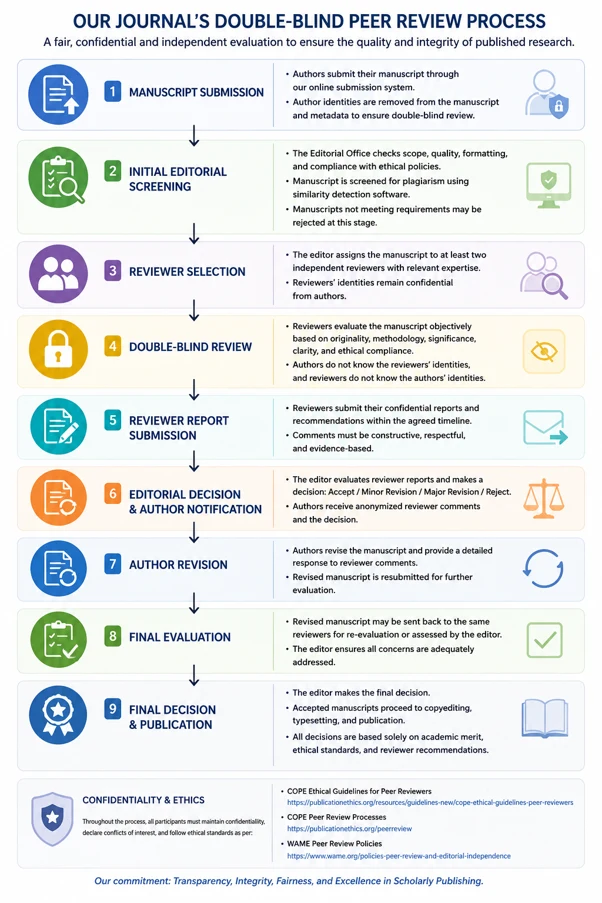
The Editorial Office operates on a double-blind peer review process which is aimed at maintaining objectivity, confidentiality, academic integrity and unbiased scholarly evaluation. The double blind review process ensures that neither authors nor reviewers reveal their identities during the course of review and editorial processing. All manuscripts submitted for consideration in IJETBM are initially screened by the editor(s) for appropriateness to ensure that the submission adheres to the aims and scope of the IJETBM and meets ethical, academic and format requirements. The manuscript might also undergo plagiarism detection prior to being sent out for review.
Once successfully reviewed by the editorial team, the manuscript is sent out to external reviewers who have relevant subject expertise and academic proficiency in the concerned field. The reviewer is supposed to make objective judgment on the manuscript based on parameters such as originality, methodological rigor, contribution to academia, clarity and suitability of the manuscript to the aims of the IJETBM.
IJETBM asks its reviewers to treat submitted materials strictly confidentially without making disclosure of the information for personal gain. The reviewer must also disclose any potential conflict of interest and decline review requests when there exists conflict of interest. The reviewer comments should be constructive, professional, evidence-based, and made during the set period for the review process. Revision requests can be made by the editor depending on the review findings. The authors should respond appropriately and give an explanation about any changes made in the manuscripts.
Publication decisions should be made by the editorial team considering review findings, ethical issues, scholarly value, originality, and contribution of the manuscript to the subject being studied. The publishing process in IJETBM is guided by international principles of peer review and publication ethics, which have been developed by COPE and WAME.
Relevant Ethical Standards and Guidance:
- COPE Ethical Guidelines for Peer Reviewers: https://publicationethics.org/resources/guidelines-new/cope-ethical-guidelines-peer-reviewers
- COPE Peer Review Processes: https://publicationethics.org/peerreview
- WAME Peer Review Policies: https://www.wame.org/policies-peer-review-and-editorial-independence
Action Plan for Reviewers and Editors
Reviewers and Editors must be expected to:
- Confidentiality during the entire process of review.
- Fair, objective, and professional evaluations of work.
- Avoid any discrimination or bias in evaluation.
- Inform about any conflict of interest immediately.
- Complete their reviews on time.
- Suggests constructive and evidence-based suggestions.
- Conserve the information from the unpublished research.
- The decision should only be based on scholarly merit and ethics.
Confidentiality and Ethical Handling of Manuscripts
All manuscripts submitted for consideration shall be regarded as confidential documents. It is inappropriate to share, discuss, distribute or make personal use of any confidential information gained during the review process.
Action Plan for Reviewers
The reviewers should:
- Observe complete confidentiality regarding all materials received for review.
- Prevent the sharing of manuscripts to unauthorized people.
- Avoid the use of information obtained during the review process in his own research work.
- Gain consent from the editor before involving colleagues in reviewing processes.
Objectivity, Fairness, and Professional Conduct
The reviewer must only judge the manuscript based on its academic value and must not discriminate against it because of the author’s nationality, ethnic background, religion, institutional association, gender, or political ideology.
Action Plan for Reviewers
The Reviewers shall:
- Comment based on facts and academic arguments.
- Choose respectful and professional wording.
- Avoid criticizing the author personally.
- Offer recommendations grounded in academia.
Reviewer Expertise and Competency
Only those in areas where they have expertise shall accept reviewing assignments.
Action Plan for Reviewers
Our Reviewers are supposed to:
- Award reviews only if they have adequate expertise.
- Refuse review assignments that fall out of their areas of expertise.
- Notify editors if they need additional expertise for evaluating a manuscript.
Conflicts of Interest in Peer Review
It is necessary for reviewers to declare a conflict of interest that could undermine their objectivity. Editorial independence, objectivity, confidentiality, and professional accountability are the responsibilities of our editorial board members and editors.
Relevant Ethical Standards and Guidance:
- COPE Core Practices: https://publicationethics.org/core-practices
- WAME Editorial Independence Policy: https://www.wame.org/editorial-independence
- ICMJE Editorial Responsibilities Guidance: https://www.icmje.org/recommendations/browse/roles-and-responsibilities/
Action Plan for Editors
Our Editors are expected to:
- Ensure fairness and objectivity in reviewing submitted manuscripts.
- Maintain the independence of their work from any commercial or other influences.
- Prevent abuse of the peer review system.
- Contribute to ethical standards in publishing.
- Deal with all submitted manuscripts professionally.